


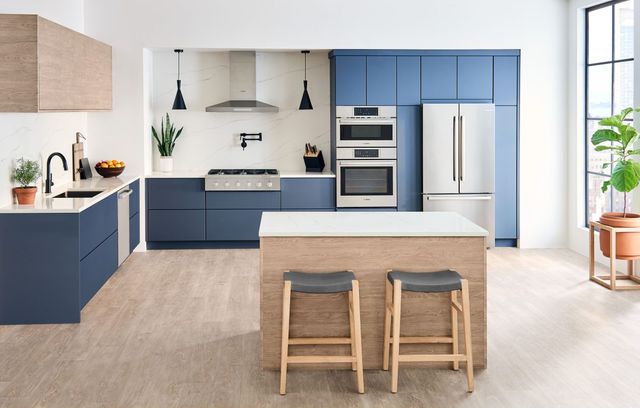
It is 6:15 on a Tuesday, a sheet pan of chicken thighs has eighteen minutes left at 425, and a bowl of leftover rice needs three minutes in the microwave. The only microwave in the kitchen is a countertop unit parked in the last usable stretch of counter beside the sink, so the cutting board with the half-chopped broccoli gets slid onto the stove, the colander goes in the sink, and dinner turns into a game of musical furniture while the timer counts down. That squeeze is the exact problem a wall oven and microwave combo was designed to solve, because it takes the microwave off the counter and puts it in the cabinet where it belongs.
See Combination Wall Ovens in Person in Bakersfield
Our Urner’s showroom lets you open the doors, compare cavity sizes, and get your cutout measured before you order. Professional installation and local in-house service included.
Here is the good news buried in that scramble: this is a solved problem, and the solution is mostly a measuring exercise. At Urner’s, our team has been fitting built-in cooking appliances into Bakersfield and Central Valley kitchens long enough to know which questions actually decide the purchase and which ones just sound important. This guide covers what a combination unit really is, how sizing and cutouts work, how a combo stacks up against the alternatives, the features worth paying for, the honest trade-offs, and the specific models worth putting on a shortlist.
Key Takeaways
• The cutout decides your shortlist before anything else: Nominal widths of 27 and 30 inches are not interchangeable without cabinet work, and overall cutout height varies between brands and product generations even at the same width.
• The upper cavity sets the price, not the oven below it: Most brands reuse a similar lower oven across their combo lineup and change what sits above it, so a sensor microwave, a convection microwave, and a speed cook cavity are what separate the tiers.
• Combination units are not vented outside: They recirculate internally, so the cooktop still needs its own range hood or downdraft to handle smoke and grease.
• One assembly means one service call and one replacement: You gain a cohesive built-in look and eye-level microwave access, but when a cavity fails you are servicing or replacing a single unit rather than one appliance.
What Is a Wall Oven and Microwave Combo? Configurations and Cooking Modes Explained
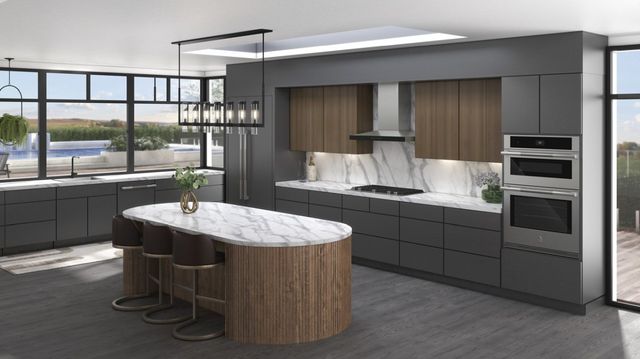
A wall oven and microwave combo is a single built-in appliance that stacks a microwave or speed oven cavity above a full-size electric wall oven inside one cabinet cutout. It is controlled as one unit, powered as one unit, and installed as one unit, which is what separates it from two appliances that happen to sit near each other.
That definition covers a lot of ground, though. Three product types show up under the same search term, and they behave differently once you are cooking.
The Three Configurations You Will Actually See
A standard combination unit pairs a sensor microwave over a convection or thermal oven. The upper cavity reheats, defrosts, and cooks the way any good microwave does, and the lower oven does the baking and roasting. This is the most common build and the one most shoppers picture.
A convection microwave combo adds a convection element and fan to the upper cavity. That means the microwave can also brown, crisp, and bake small items, so a tray of cookies or a few chicken thighs never has to wait for the big oven to preheat.
A speed oven combo goes further. The upper cavity uses halogen heat or microwave-assisted convection to cook a full dish in a fraction of conventional oven time, turning a 45-minute roast chicken into something closer to a weeknight possibility. It is the most expensive upper cavity by a wide margin, and whether it earns that money depends entirely on how you cook.
Single Cavity Versus Two Cavity
This distinction confuses shoppers constantly, so it is worth being plain about. A single cavity combination oven uses one chamber that switches between microwave, convection, and sometimes steam modes. It saves space and money, but only one job runs at a time.
The far more common two cavity design keeps the microwave and the oven fully separate. Both run at once, which is the whole point on a Tuesday night when the rice needs three minutes and the chicken needs eighteen.
What the Microwave Cavity Cannot Do
The upper cavity in a combo is a real microwave with real power, and on most models it matches or beats a countertop unit for reheating and sensor cooking. What it does not do is vent your cooktop. Combination units recirculate air internally and do not duct to the outside, so a combo is not a substitute for an over-the-range microwave in terms of ventilation.
That matters more than it sounds. If you pull an over-the-range microwave out and move to a wall combo, the space above the cooktop is now empty and unvented, and cooktop smoke and grease need somewhere to go. Most people treat that as an upgrade opportunity and add a proper range hood.
Here are the terms you will meet on spec tags and product pages: convection microwave, speed cook, sensor cooking, inverter power, true convection, air fry mode, steam assist, self-clean and steam clean cycles, Sabbath mode, and Wi-Fi connected controls. Knowing which of those you actually want narrows a confusing category fast.
One thing competitors rarely mention: the upper cavity is the real differentiator between price tiers, not the lower oven. Most brands carry a similar lower oven across their entire combo lineup and change only what sits above it. So when you compare two units from the same brand at very different prices, look up before you look down.
Read more:
Essential Electric Wall Oven Features Explained
Induction Range Types: Freestanding vs Slide In Options
Sizing, Cutout Dimensions, and Installation Requirements for a Wall Oven and Microwave Combo
Width comes first, because it drives every other decision. There are two mainstream widths in this category, 27 inch and 30 inch, plus a narrower selection of 24 inch European style combos. These are not interchangeable. Moving from 27 to 30 inches means cutting into cabinetry, and moving the other direction means filler panels and trim work.
Nominal width refers to the cabinet opening, not the appliance face. The finished trim on the unit overlaps the cabinet face frame, which is why a 30 inch combination unit does not need a 30 inch hole.
Rough Cutout Ranges and Why You Still Need the Manual
As a general guide, a 30 inch combination unit typically needs a cutout somewhere around 28 1/2 to 28 3/4 inches wide, with an overall cutout height commonly landing in the 42 to 45 inch range. A 27 inch unit usually wants roughly 25 1/2 inches of width. Treat those as orientation numbers only. Every model publishes its own required opening in the manufacturer installation manual, and that document is the only figure worth ordering against.
Three cutout dimensions get forgotten more than any others:
• Overall height of the combined opening, which is where most replacement projects run into trouble.
• Cabinet depth of at least 24 inches, measured from the face frame to the back wall.
• Distance from the bottom of the cutout to the finished floor, which decides whether the microwave lands at a comfortable reach height instead of over your head.
Electrical Requirements in Plain Language
Most combination units require a dedicated 240 volt circuit, commonly 30 to 50 amps depending on the model, either hard wired or on a receptacle behind the cabinet. A few speed oven models run the upper cavity on a separate 120 volt supply.
Older Bakersfield homes are the ones to watch here. Panels sized for a 1960s or 1970s kitchen often do not have the capacity or the spare breaker space for a modern combo, and a panel or circuit upgrade turns into part of the project. Have a licensed electrician confirm capacity before the appliance gets ordered, not after it arrives on the truck.
The Physical Realities
Combination units are heavy. Many run 200 pounds or more, which means two installers, not one enthusiastic homeowner and a neighbor. The cabinet needs support rails or a load-bearing shelf sized to carry that weight for the life of the appliance, plus the manufacturer mounting hardware, plus clearance around the unit for ventilation and full door swing.
Here is the detail our installers check on every combination job before the unit ever leaves the truck: the cutout has to be square and level across the full opening, because a combo carries two stacked doors, and any twist in the cabinet frame shows up as an uneven gap between them once the unit is set. A cutout that is a quarter inch out of square looks fine empty and looks wrong forever with an appliance in it.
Pre-Purchase Measuring Checklist
Run this before you shop, not after you fall in love with a model:
1. Measure the cutout width at the top, middle, and bottom of the opening.
2. Measure the overall cutout height from the bottom ledge to the top of the opening.
3. Measure cabinet depth from the face frame to the rear wall.
4. Measure from the finished floor to the bottom of the cutout.
5. Confirm the circuit voltage and amperage at the panel, and note the breaker size.
6. Note whether the cabinet is framed or frameless, since that changes how the trim sits.
One warning competitors skip: replacing an existing combination unit rarely drops in cleanly. Cutout height standards have shifted between brands and between product generations, so a unit from 2009 and a unit from this year can share a width and still need different openings. A trim kit, a filler panel, or minor carpentry is common. Photograph the model number plate on your old unit before you start shopping, because that plate is usually on the door frame and disappears the moment the old appliance goes on the truck.
Wall Oven and Microwave Combo vs Double Wall Oven vs Single Oven Plus Microwave
Before committing to any built-in cooking layout, it helps to see all five options side by side with the trade-offs stated plainly rather than implied.
| Configuration | Cabinet Space Needed | Simultaneous Cooking Capacity | Microwave Access Height | Vents to Outside | Service and Replacement Flexibility | Typical Installed Price Range | Best For |
|---|---|---|---|---|---|---|---|
| Wall Oven and Microwave Combo | One tall cutout, 27 or 30 inch | One full oven plus microwave that bakes small items | Eye level, no bending or reaching | No, recirculating only | Replaced as one assembly | Low to mid thousands installed | Busy weeknight kitchens, counter space recovery |
| Double Wall Oven | One tall cutout, taller opening | Two full-size cavities, no microwave | Not applicable | No | Replaced as one assembly | Mid thousands installed | High-volume baking and holiday cooking |
| Single Wall Oven Plus Over-the-Range Microwave | One oven cutout plus cooktop wall space | One full oven plus microwave | Above the cooktop, overhead reach | Yes if ducted | Each replaced separately | Lowest of the group | Budget remodels, ducted ventilation needed |
| Single Wall Oven Plus Countertop Microwave | One oven cutout plus counter run | One full oven plus microwave | Counter height, consumes counter space | No | Each replaced separately | Lowest, most flexible | Renters, tight budgets, temporary setups |
| Speed Oven Combo | One tall cutout, 27 or 30 inch | One full oven plus a true fast-cook cavity | Eye level | No | Replaced as one assembly | Highest of the group | Fast weeknight cooking, second-oven capability |
Three takeaways come out of that grid. A household that bakes in volume, runs two temperatures at once, and hosts holidays should look hard at a double wall oven and keep the microwave elsewhere. A household that reheats constantly and cooks fast weeknight meals gets more real value from a combination unit, and more still from a speed oven cavity. And a kitchen with a short cabinet run, where every linear foot of counter is already spoken for, benefits most from a combo simply because it recovers the counter the microwave was eating.
Pricing in that table reflects typical installed ranges rather than exact figures. Mainstream combination units commonly land in the low thousands, while premium and speed oven models climb substantially higher. Check current pricing on the live product pages before you budget.
Features That Actually Matter in a Wall Oven and Microwave Combo for a Busy Kitchen
Feature lists in this category run long and read the same across brands. What follows sorts them by practical impact, measured in minutes saved on a weeknight rather than bullet points on a spec sheet.
True Convection in the Lower Oven
True convection adds a third heating element behind the fan, so the air circulating through the cavity is already hot instead of just moving around. In practice, that means two racks of cookies bake evenly at the same time and the bottom rack does not come out pale. It is the single feature most worth paying for in the lower oven.
Speed Cook or Microwave-Assisted Convection Above
This is where the upper cavity stops being a microwave and starts being a second oven. A speed cook cavity can put a tray of salmon or a small roast on the table in a fraction of the conventional time, which changes what is realistic at 6:15 on a weeknight. It is also the most expensive feature in the category, so it earns its cost only if you cook, not just reheat.
Air Fry Mode
Air fry is high-speed convection with a name people recognize, and it is genuinely useful for frozen foods, wings, and vegetables. The honest note is that it works best on a single rack with a perforated pan, and it does not match a dedicated countertop air fryer for a small batch. It does replace one countertop appliance, which is worth something in a crowded kitchen.
Sensor Cooking and Inverter Power
Sensor cooking measures humidity in the cavity and shuts the microwave off when the food is done, which is the difference between reheated and rubbery. Inverter power delivers steady reduced power instead of cycling full power on and off, so a low setting actually holds a low temperature. Both are quiet upgrades that you notice every day.
Steam Assist and Cleaning Cycles
Steam assist adds moisture during baking for better crust and rise on bread, and steam clean loosens light soil with water and low heat in about 30 minutes. Self-clean uses extreme heat to burn residue to ash. Use steam clean for weekly upkeep and save the high-heat cycle for a few times a year.
Capacity, in Real Terms
Lower ovens in this category commonly run roughly 4.3 to 5.0 cubic feet in 30 inch models and less in 27 inch models. Upper microwave cavities typically run about 1.4 to 1.9 cubic feet. Translated into cookware, a 5.0 cubic foot lower oven generally handles a full-size half sheet pan and a large holiday roasting pan on the same rack position, while a 27 inch cavity may force you to a smaller pan or a taller rack arrangement. Confirm the interior width on the spec sheet if you bake on half sheet pans regularly.
Convenience Features, With a Verdict
• Wi-Fi and app control are handy for preheat and remote monitoring, but nobody buys a second unit for it.
• A temperature probe is genuinely valuable if you roast meat, and dead weight if you do not.
• Telescoping or gliding racks are worth every penny at eye level, where a heavy pan and a hot cavity meet.
• Soft close doors are pleasant and protect the hinges, which are a common long-term failure point.
• Hidden bake elements make cleanup easier and make visual element inspection impossible.
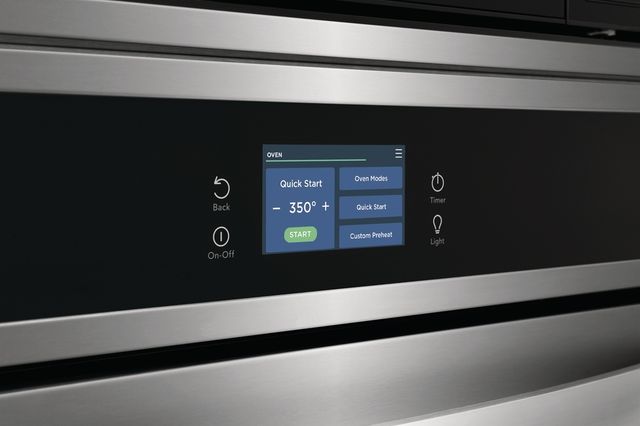
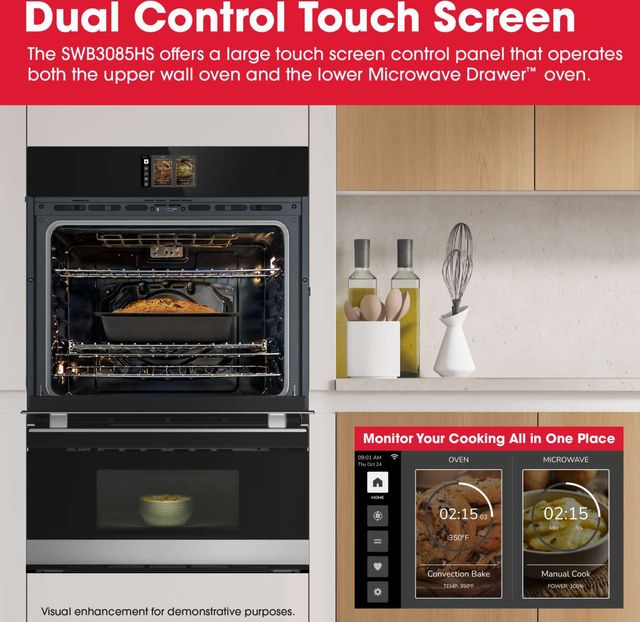
• Full color displays look sharp but do not cook better than a clear touch panel with real knobs.
Where shoppers overpay is usually connectivity, display sophistication, and preset menus they never open. Where the money is better spent is true convection, gliding racks, a strong sensor microwave, and build quality in the door and hinge assembly. Those are the parts you touch daily and the parts that decide how the appliance feels in year eight.
Brand tiers sort roughly as follows. Frigidaire and Whirlpool anchor straightforward value combinations. GE and KitchenAid sit in the broad middle with strong feature sets and wide parts availability. Bosch, Café, GE Profile, Electrolux, and Samsung compete on design and speed cook technology. JennAir, Thermador, and Monogram occupy the premium end where finishes, hardware, and speed or steam cooking all come standard. Sharp holds a distinct spot for microwave drawer configurations. LG rounds out the mainstream field with strong connected features.
Finish and design continuity deserve a note, because a combo sits at eye level and dominates a wall:
• Stainless steel remains the safest match across mixed appliance ages.
• Black stainless and matte black read as intentional only when the whole suite matches.
• White works in period kitchens but limits your model choices.
• Panel-ready looks are rare in this category, so plan around a visible appliance face.
• Handle profile matters more than color, since a bar handle next to a pro-style handle is the mismatch people notice.
A combination unit buys you space, ergonomics, and a cohesive built-in look, and it asks you to accept a higher cost and less service flexibility in return. Both sides of that trade are real, and shoppers who understand them up front are the ones who stay happy with the purchase five years later.
Pros
Reclaimed counter and wall space:
Moving the microwave into a cabinet returns a full stretch of counter to prep work and frees the wall above the cooktop.
Microwave at a comfortable height:
The upper cavity sits at chest or eye level, which removes the bending of an under-counter unit and the overhead reach of an over-the-range model.
One cohesive built-in look:
A single trimmed face at eye level reads as designed cabinetry rather than two appliances stacked together.
Both cavities run at once:
Two cavity designs let the oven roast while the microwave reheats, which is exactly the weeknight bottleneck most kitchens hit.
Faster weeknight cooking with a speed cavity:
A speed cook upper cavity handles full dishes in a fraction of conventional oven time, effectively giving you a second oven that preheats instantly.
Cons
Higher upfront and installed cost:
A combination unit costs more than a single wall oven plus a countertop microwave, and installation is a two-person job with hardware and support requirements.
Serviced and replaced as one assembly:
If the microwave cavity fails out of warranty, you are repairing or replacing a unit, not swapping a $200 appliance.
Smaller lower oven than a comparable single wall oven:
The stacked layout gives up some cavity height, which shows up when you load a tall roasting pan.
Read more:
3 Whirlpool Microwave Styles You'll Love
GE Profile vs KitchenAid: A Cooking Comparison
How to Choose the Right Wall Oven and Microwave Combo for Your Household
The selection principle is simple in sequence. Your cutout and your electrical service narrow the field first, and only after that do cooking habits decide which upper cavity is worth the money.
Match the Configuration to the Household
• A small household that reheats and cooks for two is well served by a standard sensor microwave over a convection oven. Save the money and skip speed cook.
• A family cooking full meals on weeknights should target true convection below and a convection microwave above, so small items never wait on a big preheat.
• A household that bakes and entertains in volume should compare a combo against a double wall oven honestly, and if a combo wins, buy the largest lower oven capacity available in your width.
• A full kitchen remodel where cabinetry can be built to any specification should shop the appliance first and build the opening to it, which is the one situation where a 30 inch premium or speed oven model becomes easy to fit.
Budget Tiers and What Each One Buys
Entry tier gets you a reliable two cavity unit with a sensor microwave and a thermal or basic convection oven. Everything works, nothing dazzles.
Mid tier is where true convection and air fry become standard, racks improve, and controls get easier to read. This is the sweet spot for most families and the tier we recommend most often.
Premium tier adds speed cook or steam, designer finishes and handles, heavier door hardware, and connected features that are genuinely well executed rather than tacked on. You are also paying for the visual statement, which is legitimate when the appliance anchors a wall.
The 27 Inch Versus 30 Inch Decision
Treat this as strategy, not just measurement. A 27 inch model fits older cabinet runs and tighter kitchens without carpentry, which can save real money on a project. The trade is a narrower model selection, fewer premium options, and less lower oven capacity.
A 30 inch model carries the broadest brand availability and the widest feature range in the category. If your cabinetry is already 30 inches or you are opening walls anyway, go 30.
If You Are Replacing a Failed Unit
A large share of people shopping this category are not remodeling. They are standing in front of a dead appliance. Work in this order:
1. Find the model and serial plate, usually inside the door frame or along the oven door jamb, and photograph it.
2. Measure the existing opening at width, overall height, and depth before the old unit comes out.
3. Decide between a like-for-like swap and a reconfiguration, since a taller new cutout may open up better models.
Questions to Ask Before You Order
• What is the exact required cutout width and overall height for this specific model?
• What voltage and amperage does it require, and will the existing panel support it?
• What is the realistic delivery lead time?
• Does the installation quote include cabinet modification if the opening needs adjusting?
• Is haul-away of the old unit included?
• What does the manufacturer warranty cover, and who performs local service?
Installation, Ventilation, and Long-Term Ownership of a Wall Oven and Microwave Combo
Delivery day is where a lot of this becomes real, so it is worth knowing what a professional installation actually looks like from the truck to the first test bake.
What a Professional Install Involves
1. Verify the cutout against the installation manual for that exact model.
2. Confirm the circuit and disconnect power at the panel.
3. Remove the old unit, which usually takes two people and a dolly.
4. Add or adjust support rails or the load-bearing shelf to the specified height.
5. Set the new unit with two installers, checking level and square as it goes in.
6. Secure the manufacturer mounting hardware into solid cabinet framing.
7. Connect power at the junction box and dress the wiring properly.
8. Test every cooking mode, both cavities, the door switches, and the lights before sign-off.
What Goes Wrong on a Self-Install
The failure patterns are predictable. Cutout height comes up short by an inch and the unit will not seat. Cabinet support is not rated for the weight and the shelf sags over the first year. The wire run from the junction box is too short to reach the appliance connection, which is not something you discover until the unit is halfway into the wall. Doors bind against an adjacent cabinet or a door casing because nobody checked swing clearance.
Any one of those turns a Saturday into a week. That is the practical reason most buyers use professional installation on a built-in, and why our team measures before the order rather than after.
Ventilation, One More Time
This is the most persistent misconception in the category, so it bears repeating in its own passage. Combination units use internal recirculating venting. They do not duct to the exterior. They do not capture cooktop smoke, steam, or grease.
Your cooktop still needs its own hood or downdraft, sized for the burner output below it. Moving the microwave off the cooktop wall is actually the ideal moment to add proper ventilation, since the space is already open.
Permits and Code
If your project adds a dedicated circuit or requires panel work, an electrical permit is usually part of the job. Requirements vary by jurisdiction across the Central Valley, so a local retailer and a licensed electrician should confirm what your specific address needs before work starts.
Care and Cleaning
Skip abrasive pads, bleach-based sprays, and ammonia cleaners on stainless and touch glass. Warm water, mild dish soap, and a microfiber cloth handle almost everything, with a dedicated stainless cleaner applied along the grain for streaks.
Run steam clean for routine soil and save self-clean for a few times a year. Because a self-clean cycle drives cavity temperatures far above normal cooking heat, run it in the evening or on a cooler day rather than during a Bakersfield summer afternoon when the kitchen and the air conditioning are already working hard. Keep the microwave cavity vents and the turntable area clear of spills, and replace interior bulbs and any accessible filters according to the manual.
Long-Term Ownership
Plan on a realistic 10 to 15 year service life for a built-in combination unit. Control boards and door hinges are the most common failure points, which is why door build quality matters more than the feature list at year eight. Manufacturer warranties in this category typically cover parts and labor for the first year, with limited longer coverage on select components.
Parts availability and a local service department matter far more for a built-in than for a portable appliance. A countertop microwave that dies gets replaced in an afternoon. A combination unit that dies is a wall opening with nothing in it, and the answer depends on whether someone nearby stocks the part and knows the model. Buying where installation and in-house service come from the same company means one phone call instead of a chain of handoffs between a retailer, a third-party installer, and a manufacturer hotline.
Audit Your Upper Cavity Before You Pay for Speed Cook
The most expensive decision in this category is whether to buy a speed cook or convection microwave cavity, and almost nobody makes it with actual information. Here is a one-week exercise that settles it. Every time you use your current microwave, jot down what went in and how long it ran. Do the same for the oven, noting the preheat time and what you were cooking. At the end of the week you will have a usage log that shows exactly what your upper cavity needs to do, and the pattern is usually obvious. Households whose log is full of two-minute reheats and defrost cycles do not need speed cook and should put that money into a better lower oven. Households whose log shows repeated 12-minute preheats followed by 20-minute bakes of small items are paying a heat tax every night that a speed cavity eliminates.
• Mostly reheating under three minutes, plus popcorn and defrost, points to a standard sensor microwave over a convection oven.
• Frequent small bakes of frozen items, wings, or a few pieces of fish points to a convection microwave upper cavity with air fry.
• Repeated full preheats for dishes that feed two to four people points to a true speed cook cavity, which pays for itself in reclaimed evenings.
• Heavy multi-rack baking with light microwave use points away from a combo entirely and toward a double wall oven.
• More than two entries per night in the microwave column means the ergonomics of eye-level access matter as much as the cooking technology.
• Almost no oven entries at all means the lower oven capacity question is a non-issue and you should optimize for the upper cavity.
Read more:
Stainless Steel Electric Ranges: Top Customer Picks
What Are the Top Products from Kitchenaid Appliances?
Top Wall Oven and Microwave Combos to Shop at Urner’s
The lineup below spans every profile covered above, from a narrow 27 inch replacement to a premium design statement, plus one configuration that is not a stacked combo at all. Each of these can be seen in person at our Bakersfield showroom, where our team will confirm your cutout before the order goes in. Delivery, professional installation, haul-away, and local in-house service are handled by Urner’s, not a subcontractor.
GE 27” Stainless Steel Oven Microwave Combo Electric Wall Oven

Shop Electric Oven-Micro Combo Built-In
Plenty of Bakersfield homes were built around a 27 inch built-in opening, and that one number quietly removes most of the market from consideration. This GE unit is the answer for those cabinet runs, stacking a microwave cavity above a full-size electric oven in a narrower footprint. As covered earlier, width is not negotiable without carpentry, so a like-for-like 27 inch swap keeps your project to a delivery day instead of a cabinet rebuild. The honest limitation is capacity, since a narrower cavity means less room for large pans. Confirm the overall cutout height with our team first.
Top Features
• 27 inch nominal width: Built for the narrower cabinet openings common in older Central Valley homes, where a 30 inch unit simply will not fit.
• Stacked two cavity layout: The microwave and oven operate independently, so reheating never has to wait on a roast.
• Eye-level microwave access: Removes the overhead reach of an over-the-range unit and the bending of a counter model.
• Stainless steel finish: Coordinates with existing GE and mixed-brand stainless cooking appliances already in the kitchen.
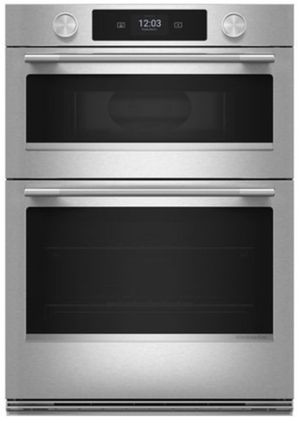
KitchenAid 30” PrintShield Stainless Steel Oven Micro Combo Electric Wall Oven with Assisted Cook Cycles
Shop Electric Oven-Micro Combo Built-In
For the cook who bakes seriously but would rather not babysit a temperature curve, the assisted cook cycles on this KitchenAid do the sequencing for you. You select the dish and the unit handles the mode, heat, and timing, which is genuinely useful in that narrow window between getting home and getting dinner on the table. The PrintShield finish resists the fingerprints a door at eye level collects constantly. The limitation worth naming is that guided cycles reward learning the menu, so plan on a few weeks of getting comfortable with the controls in your own kitchen.
Top Features
• Assisted cook cycles: Preset sequences set the mode, temperature, and time for common dishes so results repeat reliably.
• PrintShield stainless finish: Purpose-built to shed fingerprints and smudges on a surface that gets touched every day.
• 30 inch stacked configuration: Fits the most common built-in opening width with the broadest range of cabinetry options.
• Independent upper and lower cavities: Both run at the same time, which is the core weeknight advantage of the format.
Sharp Black Convection Wall Oven with Microwave Drawer Oven
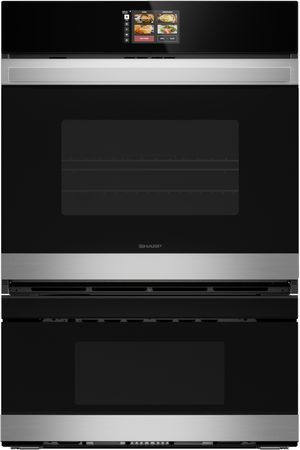
This is a different configuration, and that is the whole appeal. Rather than stacking a microwave above the oven, Sharp pairs a convection wall oven with a microwave drawer that pulls open and loads from the top. A drawer suits households with young children, shorter cooks, or anyone tired of lifting a full bowl out at chest height. It also handles tall containers a stacked cavity fights with. The honest trade is layout: a drawer typically needs its own opening, so bring your kitchen plan to our showroom rather than assuming a straight swap.
Top Features
• Microwave drawer format: Opens downward and loads from above, so nothing gets lifted across a hot oven door.
• Convection wall oven: Circulated heat delivers more even browning and better multi-rack results than a thermal-only cavity.
• Accessible for all heights: Waist-level loading works for children, shorter cooks, and anyone with limited overhead reach.
• Black finish: A quieter, more contemporary look than brushed stainless in a dark or two-tone kitchen.
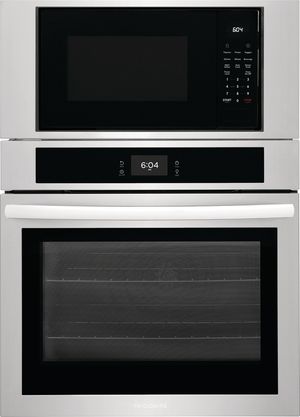
Frigidaire 30” Stainless Steel Oven Micro Combo Electric Wall Oven
Shop Electric Oven-Micro Combo Built-In
When the budget says be reasonable but the counter says the microwave has to go, this is the model that solves both. Frigidaire keeps this combination straightforward, delivering the two cavity layout and the eye-level access that make the format worth having without charging for features that go unused. It is the natural entry point for a first combination unit or a rental property upgrade in the Central Valley. The trade-off is fewer premium touches in the racks and display, which matters less if the appliance mostly needs to bake, reheat, and stay out of the way.
Top Features
• Value-focused combination layout: Delivers the core benefit of the category without premium feature pricing.
• Standard 30 inch built-in width: Sized for the most common cabinet opening, which keeps installation predictable.
• Simple, readable controls: Straightforward bake, broil, and microwave functions with no learning curve.
• Stainless steel exterior: Wipes down easily and blends with existing stainless appliances in a mixed kitchen.
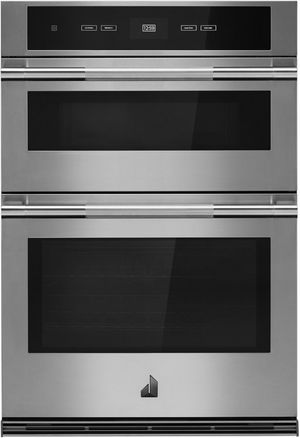
JennAir RISE 30” Stainless Steel Oven Microwave Combo Electric Wall Oven
Shop Electric Oven-Micro Combo Built-In
A combination unit occupies a full wall of cabinetry at eye level, which makes it the visual anchor of the room whether you planned it that way or not. The RISE design language is built for exactly that moment, with bold industrial styling and heavy door hardware that reads as furniture rather than appliance. This is the pick for a designed kitchen where the built-in column is meant to be looked at. The honest note is that premium design carries a premium price, so it makes the most sense when the rest of the suite matches it.
Top Features
• RISE design language: Bold industrial styling with substantial hardware built to anchor a designed kitchen wall.
• Premium door and hinge construction: Heavier hardware in the parts that get used thousands of times over the life of the unit.
• Suite coordination: Matches other JennAir RISE cooking, refrigeration, and dishwashing pieces for a consistent built-in look.
• 30 inch stacked combination: Full-size lower oven with an independent microwave cavity above in a standard opening width.
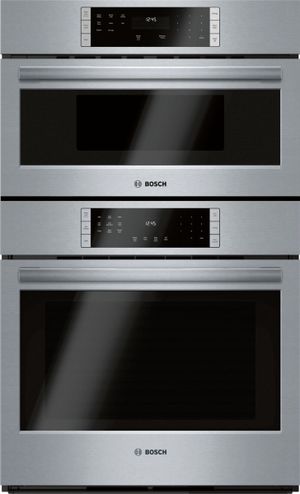
Bosch 800 Series 30” Stainless Steel Electric Built-In Oven Micro Combo
Shop Electric Oven-Micro Combo Built-In
If the goal is a built-in column that looks like cabinetry rather than equipment bolted into a hole, Bosch is the brand that has spent decades on that specific problem. The 800 Series brings European design discipline, a restrained control face, and the flush installation look that makes a combo sit tight to the cabinet face. European convection circulates air aggressively for even results across racks, which addresses the uneven baking issue raised earlier. The limitation is stylistic honesty: the minimalist interface rewards people who like clean glass over people who want physical knobs.
Top Features
• Flush installation appearance: Designed to sit tight against the cabinet face for an integrated, custom-cabinetry look.
• European convection: Circulates heated air for even browning across multiple racks at the same time.
• 800 Series build quality: Focuses on door sealing, quiet operation, and precise temperature holding rather than feature count.
• Restrained control face: Clean glass interface that keeps the visual weight down on a wall-dominating appliance.
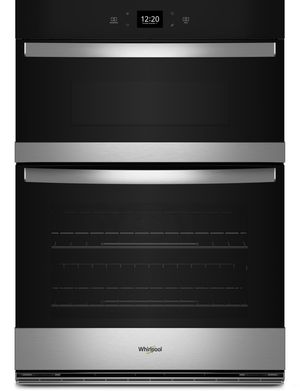
Whirlpool 30” Stainless Steel Oven Microwave Combo Electric Wall Oven
Shop Electric Oven-Micro Combo Built-In
This is the family workhorse of the group, aimed squarely at the household that cooks five nights a week and needs the appliance to simply work. Whirlpool builds familiar, unfussy controls that anyone in the house can operate without a manual, and parts support for the brand is among the best in the category, which matters a great deal on a built-in you plan to keep for a decade. Pair that with our in-house service department and long-term ownership gets much simpler. The trade-off is styling, since this unit prioritizes function over design statement.
Top Features
• Familiar, unfussy controls: Every member of the household can run both cavities without consulting a manual.
• Strong parts availability: Widely stocked components keep future repairs faster and less expensive on a built-in appliance.
• Standard 30 inch opening: Drops into the most common cabinet cutout width for a predictable installation.
• Two cavity operation: Microwave and oven run at once, handling the weeknight bottleneck this article opened with.
Choosing the Right Wall Oven and Microwave Combo for a Kitchen That Never Slows Down
The shortlist gets set by the cutout and the electrical service, the price gets set by what sits in the upper cavity, and the final call comes down to how your household actually cooks on an ordinary Tuesday. Get those three things straight and this stops being a confusing category. A combination unit gives back the counter, puts the microwave at a sane height, and lets both cavities run at once, which is exactly what a busy kitchen needs.
Come see them in person at Urner’s. Our showroom lets you open the doors, compare cavity depth against your own sheet pans, and feel the difference between a soft close hinge and a basic one before you spend a dollar. Our sales team verifies cutout and electrical requirements before your order is placed, our installation packages include haul-away of the old appliance, and our in-house service department serves Bakersfield and the Central Valley long after delivery day. That is what an independent retailer offers that a big-box counter and an online-only checkout page cannot. Browse built-in wall ovens online, call us to confirm your measurements, or stop by the showroom and bring a photo of your model number plate.
Frequently Asked Questions About Wall Oven and Microwave Combo Units
A combination unit is worth it when counter space is tight and you want the microwave at eye level in a finished built-in look. Separate appliances cost less and can be replaced individually, so the choice comes down to whether space and appearance are worth the higher cost and the single-assembly service limitation.
A 30 inch combination unit typically needs a cutout roughly 28 1/2 to 28 3/4 inches wide with an overall height commonly in the 42 to 45 inch range and at least 24 inches of cabinet depth. Those are orientation figures only, since every model publishes its own required opening in the installation manual you should verify before ordering.
No, a combination unit is built and installed as a single assembly, so an individual cavity cannot be swapped out the way a countertop microwave can. A failed microwave cavity is repaired through parts service on that specific unit, or the entire combination unit is replaced.
No, combination units use internal recirculating venting and do not duct to the exterior. That also means they do not handle cooktop smoke or grease, so your range needs its own hood or downdraft regardless of what the wall combo does.
A convection microwave combo adds a heating element and fan to the upper cavity so it can brown and bake small items in addition to microwaving. A speed oven combo goes further by using halogen or microwave-assisted convection to cook full dishes in a fraction of conventional oven time, and it costs considerably more.
Mainstream combination units commonly land in the low thousands installed, while premium and speed oven models climb substantially higher. Installation adds cost for two-person delivery, support hardware, and any cabinet or electrical work the opening requires, so confirm current pricing and an installation quote before budgeting.
Why Trust Urner's and Urner's Mattress?
Urner’s started on the back of a bicycle - yup! A bicycle! David E. Urner, a local high school teacher, who spent his summer months selling Wear Ever cookware off the back of a bicycle (think 100+ degrees). David teamed up with another local teacher, Errol P. Janes to create “a new type of store – one that would cater exclusively to providing an easier way of living for the women of Kern County”, and on September 19, 1919, Home Appliance Store was opened to the public. The store boasted a rather impressive selection of “modern” appliances, including a washing machine, a freezer, a gas range, an automatic dishwasher, and an assortment of small appliances. Since then, Urner’s has expanded selections to appliances, furniture, mattresses and cabinetry!
For nearly one century, the Urner family and Urner’s business have both been an integral part of Bakersfield and Kern County, with contributions to community (Better Business Bureau, Sister City Projects, Bakersfield Symphony), charity (Ronald McDonald House, St. Jude’s Dream Home, House of Hope) and education (CSU Bakersfield, Ray Dezember Leadership Development Center. Explore the website, visit the store, or join us socially. We’re all about home, all about fun, and all about you… and we’re ready to make you a part of the Urner’s family today.
Shop Wall Ovens and Microwave combos at Urner’s
Stop by any of the 6 Urner’s and Urner’s Mattress locations in Bakersfield, CA to see what a difference buying local with an experienced staff can make. Our friendly experts are always happy to help you explore the best dining room cabinets for your living room — whether you call us at 661-396-8400, use our online chat feature, or visit us in person.